
Artificial intelligence continues to transform the global technology industry, with major companies developing more capable AI models, smarter digital assistants, and automated tools for businesses. From software development to cybersecurity and scientific research, AI technology is becoming an increasingly important part of everyday digital life.
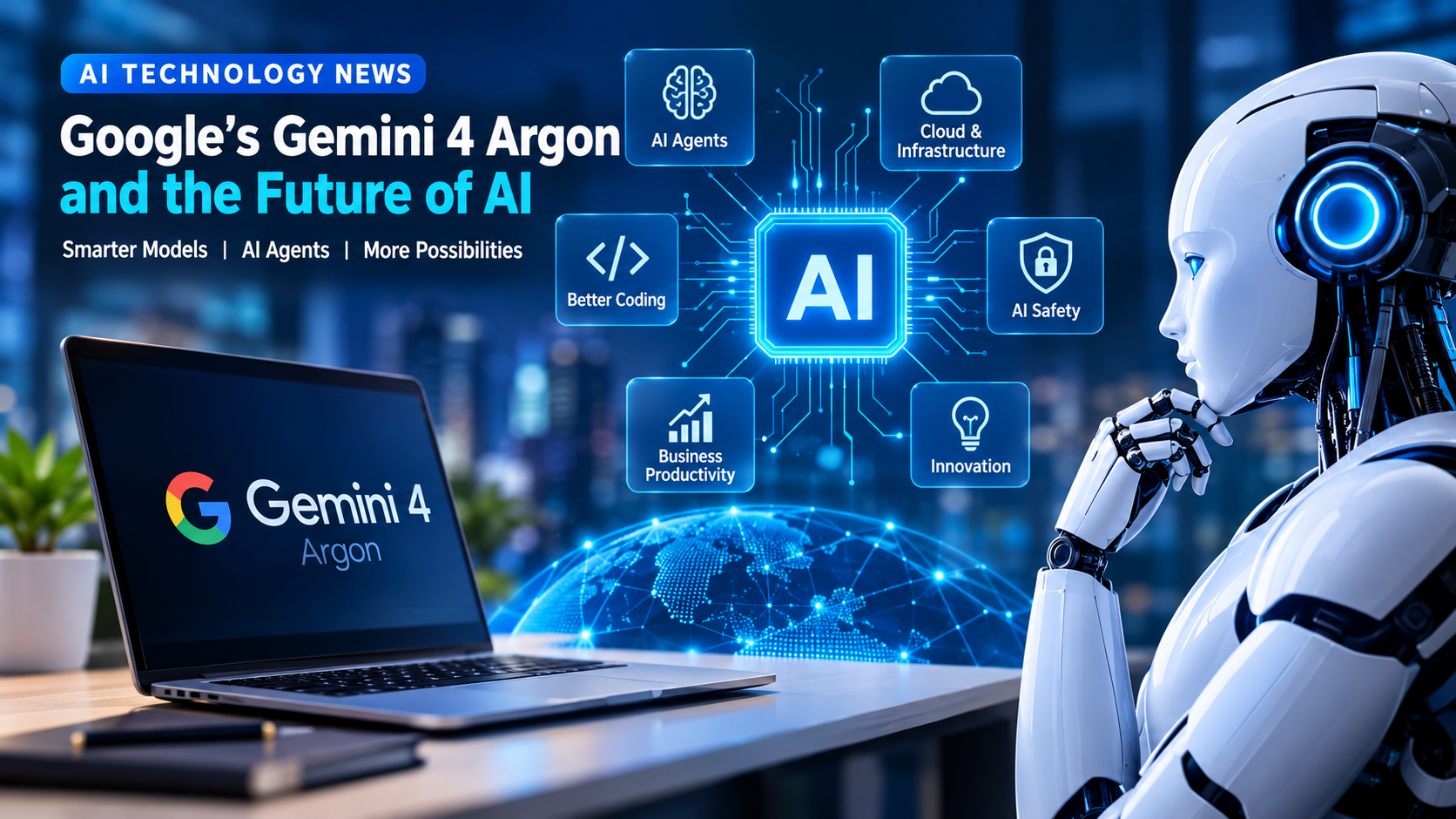
One of the latest developments is Google’s introduction of Gemini 4 Argon, a flagship AI model announced on October 13, 2026. The launch highlights the growing competition among technology companies to build AI systems capable of handling complex, multi-step tasks.
Google Introduces Gemini 4 Argon for Advanced AI Tasks
Google’s Gemini 4 Argon is designed for developers and businesses that need AI assistance with complex workflows. According to Reuters, the model targets areas including coding, finance, law, cybersecurity, and scientific research.
The announcement reflects a broader shift in artificial intelligence. Instead of focusing only on answering questions, advanced AI systems are increasingly being developed to help users complete tasks that require several connected steps.
For businesses, these capabilities could support research, software development, document analysis, and other knowledge-based activities. However, performance and reliability will depend on the specific task, implementation, and human oversight.
AI Agents Are Becoming a Major Technology Trend
AI agents are attracting growing interest because they can work through multi-step processes rather than simply generate individual responses.
Depending on their design and permissions, AI agents may be able to research information, organize data, interact with software, assist with coding, and complete parts of a business workflow.
Potential applications include:
- Business automation: Supporting repetitive administrative tasks and internal workflows.
- Software development: Helping developers write, test, and review code.
- Customer support: Assisting support teams with common questions and information retrieval.
- Research and analysis: Summarizing documents and organizing relevant findings.
- Productivity: Helping individuals plan projects and manage digital tasks.
Despite these opportunities, AI agents still require appropriate permissions, testing, monitoring, and human review, particularly when handling sensitive information or making important decisions.
AI Competition Is Expanding Beyond Software
The artificial intelligence race is not limited to AI models and applications. Technology companies are also competing to develop the computing infrastructure required to train and operate advanced systems.
Specialized processors, cloud computing platforms, data centers, and energy availability all influence the cost and performance of AI services.
Amazon, for example, announced TorchNeuron in October 2026, a tool designed to help developers run PyTorch-based AI code on its custom Trainium chips with fewer code changes. The announcement illustrates how companies are trying to make alternative AI computing platforms more accessible to developers.
More competition in AI infrastructure could give businesses additional choices when selecting computing services. Actual cost savings will depend on workload requirements, performance, compatibility, and operational expenses.
How AI Technology Could Benefit Businesses
AI tools can help organizations improve productivity when they are applied to suitable tasks and supported by effective processes.
Some potential benefits include:
1. Faster content creation
AI writing assistants can help prepare outlines, draft articles, summarize research, and improve existing content. Human editing remains important for accuracy, originality, and editorial quality.
2. Better data analysis
AI systems can help identify patterns, summarize large documents, and make complex information easier to understand.
3. Improved customer service
AI-powered assistants can help answer routine questions and direct customers to relevant information, while more complicated cases can be handled by human staff.
4. Support for software development
Developers can use AI coding tools to explore solutions, generate code, and identify potential issues. All generated code should be reviewed and tested before deployment.
5. More efficient workflows
Businesses can explore AI-powered automation for repetitive tasks, provided they maintain appropriate security, privacy, and quality controls.
AI Safety, Privacy and Reliability Remain Important
As AI systems become more capable, organizations must consider the risks associated with inaccurate outputs, data exposure, security vulnerabilities, and excessive automation.
AI-generated information can contain mistakes, even when it sounds convincing. Businesses should verify important claims, protect confidential information, and avoid giving automated systems unnecessary access to sensitive accounts or data.
Human oversight is especially important in areas such as cybersecurity, legal work, finance, healthcare, and other high-impact decisions.
Responsible AI adoption requires clear policies, suitable technical safeguards, regular testing, and accountability for the final decisions made using AI-generated information.
What Does the Future of AI Technology Look Like?
The next phase of AI development is likely to involve continued improvements in reasoning, coding assistance, multimodal capabilities, and task automation.
Competition among AI developers and infrastructure providers may also influence service pricing, accessibility, and the range of available tools.
For individuals and businesses, the most useful approach is to evaluate AI products based on real-world performance rather than promotional claims. Accuracy, security, ease of use, compatibility, and total cost should all be considered before adopting a new system.
Frequently Asked Questions About AI Technology
What is AI technology?
Artificial intelligence is a field of computing focused on systems that perform tasks such as understanding language, recognizing patterns, generating content, analyzing information, and supporting decisions.
What is the latest AI technology news in 2026?
One notable recent development is Google’s announcement of Gemini 4 Argon on October 13, 2026, aimed at complex tasks for developers and businesses. AI agents and specialized AI computing infrastructure are also important industry trends.
What are AI agents?
AI agents are systems designed to pursue tasks through multiple steps, sometimes using external tools or software. Their capabilities depend on their design, permissions, and the applications they can access.
How can small businesses use AI?
Small businesses can explore AI for content drafting, customer support, document summaries, data analysis, and repetitive administrative work. They should verify outputs and protect customer data.
Is AI technology safe to use?
AI can be useful, but it is not completely reliable or risk-free. Users should verify important information, review automated actions, and avoid sharing sensitive data with services unless their privacy and security practices are suitable.
Final Thoughts
AI technology is moving beyond basic chatbots toward systems that can assist with more complex professional and business tasks. Google’s Gemini 4 Argon announcement and developments in AI infrastructure demonstrate how quickly the industry is evolving.
For technology users, developers, and businesses, the priority should be to understand what these tools can actually do, evaluate their limitations, and adopt them responsibly.
Stay connected with AITechBazar.com for more technology news, artificial intelligence updates, software guides, and digital innovation coverage.